Another key aspect of managing your building project is working out the programme, or how long it will take. This is especially important if you want to complete by a specific date or need to find alternative accommodation whilst the work is carried out. Here is our little guide to estimating your project programme.
Showing posts with label Practice Management. Show all posts
Friday, 12 January 2024
Estimating Your Project Programme
The periods where you have most control over the programme (within reason) are during the design and non-construction times. The construction period should be governed by a contractor's build-programme, but it is common for issues to challenge this. See our post on the 'moving parts of a project'. The planning process in particular can take longer than the scheduled 8-weeks following registration.
Setting out the work-flow illustrates how long the project might take and what to expect in terms of your year (or two) ahead.
Bear in mind that, with the best will in the world, construction work is noisy, dusty and disruptive. If you are living in your home during a refurbishment, be prepared.
We hope this is useful to help visualise the sequencing of a project programme. It is recommended that you fully plan your project early and keep track of any developments. If in doubt, seek professional assistance from a qualified architect. Here at DesignBox we can offer architecture and project management services, so please contact us if you would like to discuss your project.
Labels:
DesignBox,
Practice Management,
Residential Projects
Friday, 22 December 2023
Calculating your Budget
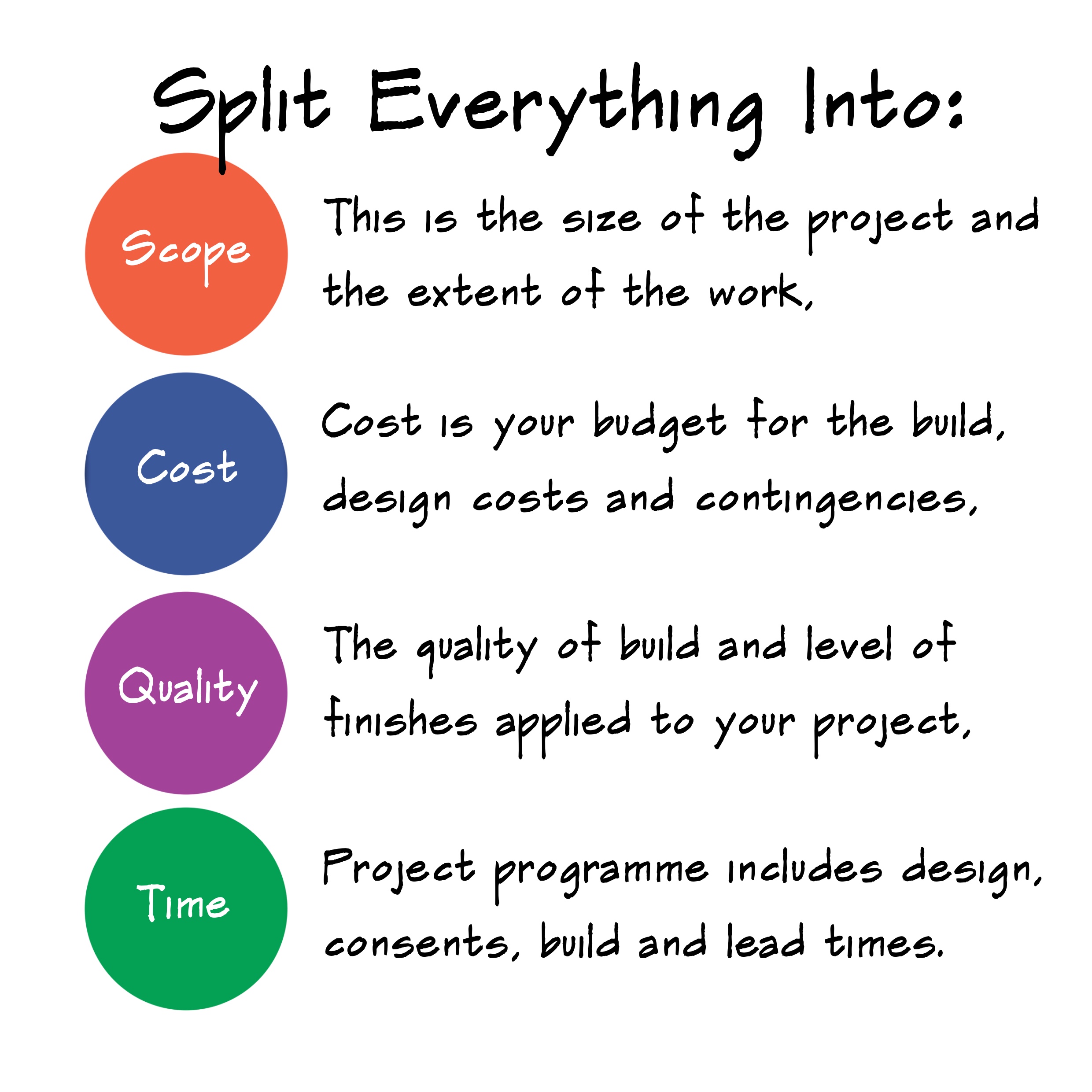
Setting the budget for your project is an important consideration. There is a lot to consider and keep control of. So here is a simplified summary of an approach to hopefully help control the process. Think of your project costs in four parts which are intrinsically linked.
Then highlight the important items within each as well as items you might accept losing if costs mount up.
Careful planning is recommended to keep control of your project. If in doubt, seek professional assistance from a qualified cost consultant.
Here at DesignBox we can offer architecture and project management services, so please contact us if you would like to discuss your project.
Additional references:
Checkatrade's average cost of a house extension: https://www.checkatrade.com/blog/cost-guides/house-extension-cost/Checkatrade's average cost of a new kitchen: https://www.checkatrade.com/blog/cost-guides/new-kitchen-cost/
Checkatrade's average cost of a loft conversion: https://www.checkatrade.com/blog/cost-guides/loft-conversion-cost/
Please note these links give estimated contract costs to which design and consents, non contract costs, contingency and VAT might need to be added.
Good luck with your project!
Labels:
DesignBox,
Practice Management,
Residential Projects
Tuesday, 28 November 2023
The Moving Parts of a Project
Starting a building project can be a daunting task if you are managing it yourself. There is a lot to consider and keep control of. So here is a simplified summary of an approach to hopefully help control the process.
It’s easy for a project to run away with itself, with costs and timescales increasing putting pressure on the nice things you want. Careful planning is required to prevent this.
The key antagonistic relationships are cost and time, against scope and quality. Changes in scope and quality during a build usually have a greater impact on cost and time than they would during the pre-build design stage.
Imagine all four parts in a diagram where the relationships are triangulated and each part connects with all the others. This helps to track the impact of one against another.
These diagrams are really the same model seen with a different central focus: The parts arranged as a tetrahedron enable us to analyse the project prioritising each area.
We hope this is be a useful tool to help visualise the mechanics of a project to assist with its control. It is highly recommended that you fully cost and set the scope for your project early in the project and regularly track them as the project develops. If in doubt, seek professional assistance from a qualified cost consultant. Here at DesignBox we can offer architecture and project management services, so please contact us if you would like to discuss your project.
Labels:
DesignBox,
Practice Management,
Residential Projects
Saturday, 21 March 2020
Project Management Tools for Architecture
Running architectural projects and managing a practice often feels like a very fluid set of activities, requiring flexible thinking and the adaptability to meet quickly changing demands in the project environment. Being able to adapt to these situations does not necessarily mean that we have to think on your feet and use our wits to progress. The RIBA Plan of work 2019 and the RIBA Handbook of Practice Management provides a framework within which to work, but project management resources developed by the Association for Project Management (APM) and AXELOS (PRINCE2) offers a comprehensive set of tools to navigate through any situation, and add value to the working methods of the architect. Road mapping projects and practice management procedures with these tools adds confidence that the project is stable and likely to proceed more efficiently, but also that these techniques can be introduced to improve the creativity and performance of the project team.
![]() |
| Examining the differences between the APMP and PRINCE2 methodologies, how they might compliment each other, and what it offers for Architectural projects and practices |
The PRINCE2 methodology is a clearly defined structure for managing projects effectively. It is unambiguous with all its processes and procedures set out in the PRINCE2 handbook. It gives the comprehensive set of tools for managing any project. The APM system is not limited to project management, including a holistic range of operational management procedures too. Unlike PRINCE2, it is not prescriptive and offers options on methods, techniques, soft skills and alternatives for the implementation of the architectural project manager. The combination of systems makes a robust set of tools with flexibility on how to use them.
![]() |
| Mapping the subject areas of Project Management which offer a very useful set of tools and resources for improving productivity in Architectural projects and practice management |
References:
- APM and PRINCE2; Five reasons why they work together, by Michelle Rowland
- APM Project Management Qualification podcasts by Qantas
Saturday, 14 March 2020
Working From Home
Internet-based phone calls, video conference calls, webinars, document sharing and editing, interactive whiteboards and VR access to events and remote locations are becoming more commonplace, allowing us to communicate, be productive, and attend events, meetings and site visits without travelling. It seems the USA is leading the way with this, but as the technologies take hold it might ultimately become the next revolution in our work place.
One strategy in innovation is to ask what if the opposite were possible. We currently live in a society with the precept that a business needs an office. The idea that we don’t need to be stationed at a specific desk, or even that a business does not need an office, might not only enable us to work from home or our favourite coffee shop, but break down current geographic, time-zone and language restrictions, allowing the businesses themselves to develop on many different levels.
It might seem to promise a more utopian work / life balance, but the technology will no doubt ensure that we can never be too far beyond the reach of our bosses, even if you do relocate to a neighbouring continent, but at least the choice of coffee should be better.
Wednesday, 10 July 2019
Project Management
To further DesignBox's credibility in project management, we are pleased to announce that we now have PRINCE2 Practitioner certification.
PRINCE2 (PRojects IN Controlled Environments) is a process based methodology for effective project management. It is used widely in the profession of project management internationally and used exclusively by the UK government. PRINCE2 protects the business justification of a project, builds a planning approach focused on achieving the project products, and divides the project in to manageable and controllable work stages. The PRINCE2 methodology helps to provide greater control of project resources, focus on the business goals and manage project risk. This helps project teams work efficiently and gives assurance to Clients.
For architecture and project management, PRINCE2 will prove invaluable to DesignBox for assisting the development of building projects, realising wider project and programme items, and tackling any innovation requirements. We look forward to applying it to our next relevant projects.
Thursday, 18 April 2019
How Simple Can Architecture Be?
During a design workshop with a school I was asked by a disgruntled sixth-form student
'Why do you architects make out that your work is so complicated? All buildings have to do is look good, function and last!'
It's true! Why do architects overthink certain areas of their work more than others, to the detriment of a 'whole-process' strategy of thinking? Architects need to ensure that their projects:
Developing this with an idea-gram, the simplicity quickly becomes populated with lots of more complicated procedures and areas of work, but bringing them in to the framework of these three points gives them relevance, importance and establishes context.
This idea-gram was thrown together with ideas considered relevant to this context. Every Architect will have a different response. Several of the areas included here extend beyond the standard Architect's scope of work, suggesting greater integration with project management, construction management, logistics and service & maintenance areas for example. To ensure these three headline criteria are successful, perhaps architecture does require a greater degree of involvement with other parties engaged in the construction, operation, service and maintenance of a project?
'Why do you architects make out that your work is so complicated? All buildings have to do is look good, function and last!'
It's true! Why do architects overthink certain areas of their work more than others, to the detriment of a 'whole-process' strategy of thinking? Architects need to ensure that their projects:
- will look good
- function properly
- will last
Developing this with an idea-gram, the simplicity quickly becomes populated with lots of more complicated procedures and areas of work, but bringing them in to the framework of these three points gives them relevance, importance and establishes context.
![]() |
| Some considerations added to this simple framework |
Friday, 27 March 2015
Architecture is...
According to the Dictionary, the definition of Architecture is,
Architecture (noun)
- The profession of designing buildings, open areas, communities, and other artificial construction environments, usually with some regard to aesthetic effect. Architecture often includes design or selection of furnishings and decorations, supervision of construction work, and the examination, restoration, or re-modelling of existing buildings.
- The character or style of a building
- The action or process of building; construction
- The result or product of architectural work, as a building
- Buildings collectively
- A fundamental underlying design of computer hardware, software, or both
- The structure of anything, e.g. the architecture of a novel
There's a lot more to it than that. Having to explain Architecture to a class of 10 year olds, I really need a single line definition which sparks the imagination. Our sequence of workshops helps to create a feel for the profession:
- Imagining ideas to address design requirements
- Investigating design with structures, drawing, materials and models
- Creating exciting, meaningful and responsive environments
- Building at full scale
Architecture is involved with everything in our lives, our societies and our existence as humans. Eva Jirikna points this out.
As Architects, our working relationships with others is key. Jan Knippers noted that historically Engineers were referred to as a 'clever person' and Architects as 'someone who knows how to put it together'. Architects like to think of themselves as designers / creators. In practice, coordination plays a big part of day to day work. Architects usually work with Structural and Service Engineers and Cost Consultants, but there's a set of skills involved which can just as easily be used with other specialists to be innovative with different kinds of projects.
Anthony Hudson refers to the importance of having an open mind in his book of his work.
Sophie Abrahams' web site Architecture Is sets out to convey the diverse nature of this subject with a patchwork of definitions which combining to illustrate the aubject.
Many people don't really know what an Architect does. I've heard someone saying 'an Architect is a kind of Surveyor'. And several architects are not completely sure what an Architect does either.
In college we came to the conclusion that Architectural education was a process of stripping away everything we thought we knew about the world, until we knew absolutely nothing about everything. It sounds contradictory to a learning process but there is a balance and potentially sensitive understanding to an approach to the world as a result.
Architecture is an activity which involves just about everything, either in terms of design approach or coordination. For me, the key areas of activity might be boiled down to:
- Ontological and metaphysical references
- Spacial design
- Technical coordination of structural, environmental and budget requirements
- Social responsibility
- Innovation, experimentation and influence of change
- Practicalities of prefabrication, construction and logistics
- Joy
So, when I'm working with a class of 10 year olds, and they ask what Architecture is, the answer I give is 'lets experiment and find out...'
Let me know if I've missed anything out. Architecture is a very fluid subject. Your comments welcome.
Friday, 5 September 2014
How to Innovate
Innovation is something of a buzz-word in the architectural press, but there is not much out there to define what innovation is or how to achieve it. The Architectural profession and Building Industry do not innovate as much as they could, or should. Development guidance for Architectural practices often follows an approach based on establishing and marketing a vision for the practice which places it in the hierarchy of the competition, within an established sector framework. The result is that everyone is largely pitching for a place in the same pool where difference is limited by specialist design areas and size of projects, and that's what we base our USPs on. This pool is defined by the professional structures of the Building Industry, the very structures which often act as boundaries and negate innovation. But what if we were able to move these boundaries?
Phil McKinney's book Beyond the Obvious is an inspirational resource. It describes the methods for establishing a business innovation strategy and how to manage it. The practices it teaches are not bound to conforming to the established patterns of an industrial sector. Instead they seek to challenge them. They are not limited to seeing how one practice can raise its position in the pecking order of other practices. Instead they challenge you to think how to stand apart from the rest, not just above. Beyond the Obvious combines many techniques such as brainstorming and lateral thinking, with Killer Questions to encourage organisations to have the bravest ideas - ideas which could be game-changing, not just to the business but to the industry itself.
It's a must read for any practice wanting to innovate, grow, develop, economise, or even play with creative ideas (because that's what Architects like to do - right?). The book describes very precisely the methodology for establishing an innovative culture in to your business practice, and road mapping a way forward to a more creative, dynamic and profitable future. I'd recommend bolting it into your (streamlined, efficient, engaging and user friendly) QA system, to ensure it is integrated in to the heart of your business practice.
Thanks Phil!
Sunday, 18 May 2014
Your Competitive Advantage
Linda
Roberts and Louise Harrison run designed2win (d2w), a consultancy
focused on, amongst other things, helping Architects to maximise their chances
of success in the competition process. For many small and aspiring
practices, competitions can be a valuable method to gain exposure, win new work
and demonstrate specialist skills and innovation but unfortunately the market
place is full of such small, aspiring practices seeking to get ahead. Linda and Louise both have over 20 years
experience of organising architectural competitions which they gained when they
headed up the RIBA's competition office.
They are in a perfect position to help. Between them they have organised and attended
over 100 competition assessments – their clients include Guy’s & St Thomas’
Hospital, the Welsh Assembly, Urban Splash, BRE, as well as over 30 different
Local Authorities. Working with the
British Antarctic Survey, they also ran the competition for Halley VI, a
competition which is very close to my heart.
With
this experience, unique knowledge and insight Linda and Louise can advise how
you can stand out from the crowd. They have been working with young
practices, honing their skills in three key areas - open design
competitions, expressions of interest and competition interviews. Here
are some of their inside tips:
General advice
Be economical, precise and focused with your workload.
Examine the tone and requirements of the brief and analyse how your submission
should respond. This is one of the key areas d2w can help with.
Judging the brief is a tricky issue. How you interpret it can make or
break your submission chances.
How you relay this to your design responses is another fundamental
issue. Is there a novel approach that will help your proposals stand out
from the crowd? Will it back-fire? Nobody wants to spend long hours
on a submission to miss the mark, which is where d2w can help.
Open design competitions
How to detect key issues in the competition brief is
critical. Then, knowing how far to develop your responses is just as
important. When should your submission be prescriptive and detailed, and when
should it be loose and enigmatic? These are some key issues d2w examine
in their workshops.
Many
open competitions request presentation boards and a written document.
Knowing how to manage these to convey your ideas and messages effectively is
something they can help with. How you set out your work is vital. A combination of presentation techniques can help
to make your submission stand out. Linda
and Louise have attended countless assessments and have supported the judging
teams for hundreds of competitions and know how this can work.
Expressions of interest
A
key problem for small architectural practices is how to compete with the big
guns when company accounts and business size are assessed against your ability
to handle their projects. One method from my own experience for Halley VI
was to team up with a larger organisation as the lead consultant. For
projects of a technical nature requiring a multi-disciplinary approach this can
be effective. But this is only part of the solution - d2w
can advise how to convey this arrangement as a winning working relationship
which can capture the interest and enthusiasm of the client and
judges.
If
you have a set number of pages to express a design response, make sure they
tell your story effectively. d2w can advise on how to convey your message
in this process.
Competition interviews
Be prepared. Confidence is key, but to establish team
confidence, the preparation needs to be effective and thorough. Knowing
what not to take can be as important as knowing what to take. Selecting
team members and knowing how to interact in the interview environment is
critical. Being sharp and slick doesn’t come without the correct
practice, which is what d2w can advise on.
Summary
Overall, be economical with your work to hit the target as
efficiently and as effectively as possible. Don’t waste precious time.
This is just a taste of the areas Linda and Louise cover in their
workshops. If you need some expert help with your killer
competition submission, contact d2w.
![]() |
| To illustrate one point, Peter Cook's sketches for the Abedian School of Architecture competition proved to be a point of interest for the submission. He tells the story in his UCL lecture. |
Friday, 25 April 2014
Killer Innovations
I've recently become a fan of Phil McKinney. For those interested in innovation (and everyone should be), Phil is a key person to know. His public work focuses on innovation management strategies, and how to bring the best out of any company, with Killer Innovations. As well as his web site, he also has a blog (included in our blog roll), a pod cast which he has run for almost ten years, and a book. All of these channels are really worth exploring! Phil also studied Architecture at college, so his thinking and approach will not be lost to the tired, fragmented mechanics of the building industry. A starting point for me was Phil's 7 Immutable Laws of Innovation.
In this post I'd like to take a look at these laws and how they work, and discuss them in relation to previous posts here about innovation within architecture and the building sector. The intention is to see if Phil's laws raise any areas of opportunity where innovation can be improved in our industrial sector.
1 Leadership
The MD or CEO of any business has to set the culture of the organisation to be focused on innovation, and allow a mechanism to develop where by innovation can become a core activity of the company.
2 Culture
Phil says 'Culture eats strategy for lunch!' The culture within the business needs to be right for a strategy of innovation to develop. Employees need to buy in to the common focus and goals of the company, engage with and take ownership of the strategy and collectively nurture ideas.
The organisational framework by which this can happen is critical. Phil discusses several strategies in his blogs and pod-casts, and expands on how they work in his book. These first two laws have parallels with our earlier blog post on the importance of people to innovation. Without the right people in the right roles, working in a common direction, innovation will not happen. What Phil offers is that all important road-map to plan your route to success.
Another point to make here is 'what is meant by innovation?' It is a buzz-word used over and over in the Architectural press without clear definition. Phil McKinney is very clear on what innovation is, and what a company needs to do to make incremental or breakthrough changes. Key to this process are the Killer Questions the company needs to ask of itself.
Phil notes that departments and disciplines across any company (or collection of companies) needs to be aligned with clear lines of communication and transparent working methods, to enable innovation strategies to remain focused, effective and efficient. This is perhaps where the Building industry struggles the most as there is not one clear instigator of innovation. Producers, suppliers, design consultants, client organisations and governmental bodies are all focused on different priorities. Arguably, the fragmented nature of the industry means companies innovate within their own parameters, with larger, breakthrough innovations proving difficult. The result is that the Building Industry sits in the traditionalist innovation camp, as noted earlier.
3 Resources
Phil notes the resources vital to developing innovations are time, people and costs, with teams working with autonomy to prescribed goals and delivery gate-posts.
In architecture, by contrast work is driven by projects and innovation normally has to fit in to budget restrictions, Client requirements, risk assessments and statutory legislation. By comparison to other industrial sectors, the incentive for innovation in building design is not as high as it could be. The situation with producers, suppliers and some large contracting companies is different, but could it benefit from greater alignment with design professionals or with a number of strategically selected companies across the industry?
4 Patience
Phil says R&D is a risk, a bet, but it needs to be given time and the patience to allow it to happen.
Within the design side of the Building Industry, project programmes and the Client's brief with tight deadlines often dictate. As a result, innovation normally gives way to tried and tested methods which prevent new thinking.
5 Process
Phil describes innovation as a continual process. What you are looking for is not 'in the last place you look'. The goal requires a process of continued searching and investigation. This process needs to capture the full innovation sequence from idea to execution and he has many strategies to establish and manage this. Phil adds that without innovation, a business (or industrial sector) stagnates. This a danger for the building industry. There is a lot of talk in the press about innovation in building design and construction but I think we are missing many key opportunities to do better. Why can't innovation within the building industry be as dynamic as other, faster moving, industrial sectors? It has a lot to do with its large fragmented professional structure, poor communication links, lack of alignment and, as Phil points out here, the lack of an effective (killer) innovation strategy at the heart of each company's management system. This law reinforces points 1 and 2 above, where innovation needs to be an integral part of the culture of a company: The process provides the road-map to achieve this.
Most design practices have a QA system. Gearing it up to take advantage of a comprehensive innovation strategy could prove very effective. If the critical mass of practices adopted this approach, it could start to shake up the sector.
6 The BHAG
The Big Hairy Audacious Goal! Phil encourages that we should go for the long shot! Do stuff never been done before! With the impossible task to complete we need to find new ways of hitting the targets. Its an inspiring and encouraging message and often the BHAG causes the innovation process (law 5) and the culture of innovation (laws 1 and 2) to be set in place. Clear targets and goals need to align with a clear innovation strategy.
This is what architecture and the building industry needs more of. Sometimes the architectural practice can set the BHAG by taking a competition brief and turning it on its head. Sometimes the Client sets the BHAG with a set of goals that sends a spark through the industry. Examples include the London Millennium Bridge and the Halley VI Antarctic Research Station.
Phil's message is like a shot of confidence: Establish the culture, set the strategy and take a leap of faith.
7 Execution
This is the translation of idea to impact. Execution is the delivery of something of value in to the market place. From what we currently produce compared to his laws (above), Phil asks us to rank ourselves as innovators. He doesn't sound like the kind of guy to be too impressed with stylistic or aesthetic developments or cost reductions. He's looking for more radical, far reaching developments, perhaps of the type listed in our 6 P's of innovation.
Take a look at Phil's work. Establish a framework to make it as easy as possible to set these 7 laws in place, to travel from ground breaking idea to the execution of killer innovations!
![]() |
| Phil McKinney's 7 Immutable Laws of Innovation, assembled in to a suggested work flow cycle |
In this post I'd like to take a look at these laws and how they work, and discuss them in relation to previous posts here about innovation within architecture and the building sector. The intention is to see if Phil's laws raise any areas of opportunity where innovation can be improved in our industrial sector.
1 Leadership
The MD or CEO of any business has to set the culture of the organisation to be focused on innovation, and allow a mechanism to develop where by innovation can become a core activity of the company.
2 Culture
Phil says 'Culture eats strategy for lunch!' The culture within the business needs to be right for a strategy of innovation to develop. Employees need to buy in to the common focus and goals of the company, engage with and take ownership of the strategy and collectively nurture ideas.
The organisational framework by which this can happen is critical. Phil discusses several strategies in his blogs and pod-casts, and expands on how they work in his book. These first two laws have parallels with our earlier blog post on the importance of people to innovation. Without the right people in the right roles, working in a common direction, innovation will not happen. What Phil offers is that all important road-map to plan your route to success.
Another point to make here is 'what is meant by innovation?' It is a buzz-word used over and over in the Architectural press without clear definition. Phil McKinney is very clear on what innovation is, and what a company needs to do to make incremental or breakthrough changes. Key to this process are the Killer Questions the company needs to ask of itself.
Phil notes that departments and disciplines across any company (or collection of companies) needs to be aligned with clear lines of communication and transparent working methods, to enable innovation strategies to remain focused, effective and efficient. This is perhaps where the Building industry struggles the most as there is not one clear instigator of innovation. Producers, suppliers, design consultants, client organisations and governmental bodies are all focused on different priorities. Arguably, the fragmented nature of the industry means companies innovate within their own parameters, with larger, breakthrough innovations proving difficult. The result is that the Building Industry sits in the traditionalist innovation camp, as noted earlier.
3 Resources
Phil notes the resources vital to developing innovations are time, people and costs, with teams working with autonomy to prescribed goals and delivery gate-posts.
In architecture, by contrast work is driven by projects and innovation normally has to fit in to budget restrictions, Client requirements, risk assessments and statutory legislation. By comparison to other industrial sectors, the incentive for innovation in building design is not as high as it could be. The situation with producers, suppliers and some large contracting companies is different, but could it benefit from greater alignment with design professionals or with a number of strategically selected companies across the industry?
4 Patience
Phil says R&D is a risk, a bet, but it needs to be given time and the patience to allow it to happen.
Within the design side of the Building Industry, project programmes and the Client's brief with tight deadlines often dictate. As a result, innovation normally gives way to tried and tested methods which prevent new thinking.
5 Process
Phil describes innovation as a continual process. What you are looking for is not 'in the last place you look'. The goal requires a process of continued searching and investigation. This process needs to capture the full innovation sequence from idea to execution and he has many strategies to establish and manage this. Phil adds that without innovation, a business (or industrial sector) stagnates. This a danger for the building industry. There is a lot of talk in the press about innovation in building design and construction but I think we are missing many key opportunities to do better. Why can't innovation within the building industry be as dynamic as other, faster moving, industrial sectors? It has a lot to do with its large fragmented professional structure, poor communication links, lack of alignment and, as Phil points out here, the lack of an effective (killer) innovation strategy at the heart of each company's management system. This law reinforces points 1 and 2 above, where innovation needs to be an integral part of the culture of a company: The process provides the road-map to achieve this.
Most design practices have a QA system. Gearing it up to take advantage of a comprehensive innovation strategy could prove very effective. If the critical mass of practices adopted this approach, it could start to shake up the sector.
6 The BHAG
The Big Hairy Audacious Goal! Phil encourages that we should go for the long shot! Do stuff never been done before! With the impossible task to complete we need to find new ways of hitting the targets. Its an inspiring and encouraging message and often the BHAG causes the innovation process (law 5) and the culture of innovation (laws 1 and 2) to be set in place. Clear targets and goals need to align with a clear innovation strategy.
This is what architecture and the building industry needs more of. Sometimes the architectural practice can set the BHAG by taking a competition brief and turning it on its head. Sometimes the Client sets the BHAG with a set of goals that sends a spark through the industry. Examples include the London Millennium Bridge and the Halley VI Antarctic Research Station.
Phil's message is like a shot of confidence: Establish the culture, set the strategy and take a leap of faith.
7 Execution
This is the translation of idea to impact. Execution is the delivery of something of value in to the market place. From what we currently produce compared to his laws (above), Phil asks us to rank ourselves as innovators. He doesn't sound like the kind of guy to be too impressed with stylistic or aesthetic developments or cost reductions. He's looking for more radical, far reaching developments, perhaps of the type listed in our 6 P's of innovation.
Take a look at Phil's work. Establish a framework to make it as easy as possible to set these 7 laws in place, to travel from ground breaking idea to the execution of killer innovations!
Sunday, 9 February 2014
Innovation begins with people
![]() |
| Innovation in the Building Industry. |
Innovation begins with people
A previous post looked at innovation in architecture. The diagram above is a development of this, following discussions with a Client (a large building contractor and design consultancy). The importance of people to innovation and industrial progress was quickly identified as the most important factor. Innovation begins with people, their ability to see opportunities for improvement, and their ability to implement them. This is illustrated when the diagram is unpicked to show how it works in relation to the development of innovation in the building industry.
![]() |
| Innovation development flow with People at the centre |
Innovation is also about looking outside the professional structures of the Building Industry. The recent Future Systems article in Building Design (BD) identified in 1984 that the aircraft industry as being 50 years in advance of the building industry. To catch up we have to make adjustments to the way in which we work, change our professional structure in some way - make people innovation, not just focus on products. Instead if working with the standard building design team (architects, structural and service engineers etc.) we need to engage with professionals in these other, apparently more progressive fields:
The usual precedents are to areas of the transport industry:
- Rail
- Automobile
- Aircraft
- Yacht and boat building
From experience, economies of scale work often against the Building Industry. Transport is a mass production industry and buildings are often about low volume production or single items. Instead of targeting big players in the transport sector (eg Bombardier), look at instead smaller manufacturing companies or smaller suppliers to the big guys (eg Advanced Composite Systems). These specialist manufacturers also have long established connections to their specialist design consultants.
It is still worth keeping an eye on innovations coming out of organisations such as BAE and Qinetiq.
To work more like these industries we should think more like them too. Top Gear assesses cars partly on their power to weight ratio. It's not very often we hear about buildings being designed with an optimised surface area to volume ratio, which is important to minimise heat loss and air leakage.
Futurism
Some areas to look at for inspiration and innovation for the Building industry include:
3D printing
3D printing will revolutionise the Building Industry. Where BIM is being dragged in to our industrial sector, 3D printing will hit it like a rocket. The technology is developing rapidly and with this the bar for entry to this technology is dropping. 3D printers can be purchased from Maplin and ebay for just over £500 with software. Once where the Building Industry had problems keeping up with the complex geometric design requirements of architects and designers, with 3D printing there will be no limit to the complexity of forms. There will also be no limit dictated by economies of scale because each component item can be made bespoke.
This innovation and the freedom it potentially brings, could mean that we break free from our reliance on right-angles and rectangles, which for the past three millennia have been the basis for setting out buildings, floor plans, walls, fixtures and fittings (tables etc). Instead the prime design parameters might be limited only to the vertical z axis, gravity and performance loads. Buildings might look more like aircraft or boats, where design is dictated by performance, or become completely free-form.
Biological systems
Beyond biomimicry and biomutualism, buildings one day might simply be biological, able to generate heat and provide warm air and with minimal heat loss to the outside, purify water and manage light transmission as a controlled living organism. Imagine one day buildings might be grown rather than built, have a life-cycle, be totally biodegradable or require a building medic.
Integrated components
In the future components might have several integrated roles. For example FRP carbon components can act as structural members, have aesthetic value as visible items, and operate as fuel cells. Thinking like this can potentially reduce the amount of material resources used to produce a building, but will require a much tighter integration of roles within the design team, where currently building envelope, structure and services are all produced separately: A people innovation.
Control systems
Control systems to buildings are becoming more and more sophisticated and our lives becoming ever more reliant on smart phones and tablets. Not surprisingly there are already apps which can manage a building's control systems from an app.
Materials
Beyond the building industry there are many innovations in materials to draw inspiration from. As well as looking beyond our industrial sector or to nature, this too requires a greater integration between the working methods of design professionals, to combine their efforts on single components.
Moving architecture
Where building design is considered more as an assembly of components with greater prefabrication and off-site production, combined with greater precision from CAD software and digitised production, buildings can potentially adopt more moving parts to enable them to move, transform or relocate with autonomy.
Reliance on resources
Energy prices are increasing and government incentive is (partly) to economise on fuel use. Innovative thinking can allow us to greatly reduce our reliance on the utilities with developments such as fuel cells, or free us from them altogether with self-sufficient buildings.
Buildings with feelings
Beyond BIM, buildings might be fitted with sensors to let owners and occupants know when something needs attention. Sudden motion sensors (SMS) and Microelectromechanical systems (MEM) are the tiny devices found in games consoles (Nintendo Wii and Xbox) and smart phones. Quantities of these sensors entering our environment is growing rapidly and there are moves to connect as many as possible over the internet, to monitor the status of our wider local, national and global environments. Structural Health Monitoring (SHM), where many buildings are connected through their sensors, will offer greater accuracy in understanding the earth's seismic patterns and environmental conditions, including wind loads, rainfall and even air quality. Detailed data will help us make the connections between local and global earth systems to assist our understanding of problems like flood patterns, for example.
It's all out there and people make it happen.
How innovative is the Building Industry?
Chapter 11 in the Economics of Industrial Innovation examines the degrees to which businesses and industrial sectors are innovative. It is very revealing and sets out four camps of business innovation:
Offensive innovators
These are often market leaders with new products and a strong reliance on science and technology. R&D plays a key role and the organisation seeks new possibilities and opportunities to move in to. Where a market opportunity is identified, it is actively moved in to. The best key specialists and individuals are recruited and acquire their knowledge from multiple or diverse sources. Communication is critical across the organisation with clear professional structures and division of labour. Often bottom-up communication (or reverse engineering) is used. Often young organisations, but with lots of people innovation!
Defensive innovators
This sometimes applies to once offensive innovators which then rest on their laurels as the business or organisation matures and their target market share is achieved.
Imitative innovators
These follow up on the work of others. They do not necessarily copy but maintain a market position working with or in support to the first two types of innovators.
Traditionalist
Here the organisational structure of the business or industrial sector changes little. This is partly because of low demand from the market to change the product. It is essentially led by fashion (aesthetics and style), which it uses as it's greatest strength and selling point. The organisational structure is fragmented often with poor communication between parties. It can rely a lot on craft based skills with minimal scientific input. QA is used to regulate and control, with the greatest influences to innovation and technological shift coming from legislation and government policy.
This might read like the life-cycle of industry with younger organisations at the top and the oldest at the bottom, but how many similarities are there between the Building Industry and the traditionalist camp?
Within this camp though, there are innovators working away. An old(ish) article from BD lists some of the movers and shakers.
This analysis of innovation camps also offers suggestions of how the Building Industry and businesses within it might revitalise and break free of the traditionalist set, to become more vibrant. It's all possible, it just takes people.
It is still worth keeping an eye on innovations coming out of organisations such as BAE and Qinetiq.
![]() |
| BAE 3D printing parts for the Tornado jet |
![]() |
| Qinetiq's developments in electric ion propulsion saves fuel and resources, manoeuvring objects in orbit |
To work more like these industries we should think more like them too. Top Gear assesses cars partly on their power to weight ratio. It's not very often we hear about buildings being designed with an optimised surface area to volume ratio, which is important to minimise heat loss and air leakage.
Futurism
Some areas to look at for inspiration and innovation for the Building industry include:
3D printing
3D printing will revolutionise the Building Industry. Where BIM is being dragged in to our industrial sector, 3D printing will hit it like a rocket. The technology is developing rapidly and with this the bar for entry to this technology is dropping. 3D printers can be purchased from Maplin and ebay for just over £500 with software. Once where the Building Industry had problems keeping up with the complex geometric design requirements of architects and designers, with 3D printing there will be no limit to the complexity of forms. There will also be no limit dictated by economies of scale because each component item can be made bespoke.
This innovation and the freedom it potentially brings, could mean that we break free from our reliance on right-angles and rectangles, which for the past three millennia have been the basis for setting out buildings, floor plans, walls, fixtures and fittings (tables etc). Instead the prime design parameters might be limited only to the vertical z axis, gravity and performance loads. Buildings might look more like aircraft or boats, where design is dictated by performance, or become completely free-form.
Biological systems
Beyond biomimicry and biomutualism, buildings one day might simply be biological, able to generate heat and provide warm air and with minimal heat loss to the outside, purify water and manage light transmission as a controlled living organism. Imagine one day buildings might be grown rather than built, have a life-cycle, be totally biodegradable or require a building medic.
Integrated components
In the future components might have several integrated roles. For example FRP carbon components can act as structural members, have aesthetic value as visible items, and operate as fuel cells. Thinking like this can potentially reduce the amount of material resources used to produce a building, but will require a much tighter integration of roles within the design team, where currently building envelope, structure and services are all produced separately: A people innovation.
![]() |
| The Lola-Drayson electric racing car experiments with cells integrated within the carbon monocoque structure to power the car's controls |
Control systems
Control systems to buildings are becoming more and more sophisticated and our lives becoming ever more reliant on smart phones and tablets. Not surprisingly there are already apps which can manage a building's control systems from an app.
Materials
Beyond the building industry there are many innovations in materials to draw inspiration from. As well as looking beyond our industrial sector or to nature, this too requires a greater integration between the working methods of design professionals, to combine their efforts on single components.
![]() |
| Plastic compound becomes stronger when stressed |
Moving architecture
Where building design is considered more as an assembly of components with greater prefabrication and off-site production, combined with greater precision from CAD software and digitised production, buildings can potentially adopt more moving parts to enable them to move, transform or relocate with autonomy.
![]() |
| The hydraulic systems on a CAT digger. It is possible to have hydraulic systems in a building, similar to those in an industrial vehicle |
![]() |
| Electroactive polymers change shape with electric currents. Combine this example with Buckminster Fuller's Cloud 9 project and we have cities in the sky! |
Reliance on resources
Energy prices are increasing and government incentive is (partly) to economise on fuel use. Innovative thinking can allow us to greatly reduce our reliance on the utilities with developments such as fuel cells, or free us from them altogether with self-sufficient buildings.
Buildings with feelings
Beyond BIM, buildings might be fitted with sensors to let owners and occupants know when something needs attention. Sudden motion sensors (SMS) and Microelectromechanical systems (MEM) are the tiny devices found in games consoles (Nintendo Wii and Xbox) and smart phones. Quantities of these sensors entering our environment is growing rapidly and there are moves to connect as many as possible over the internet, to monitor the status of our wider local, national and global environments. Structural Health Monitoring (SHM), where many buildings are connected through their sensors, will offer greater accuracy in understanding the earth's seismic patterns and environmental conditions, including wind loads, rainfall and even air quality. Detailed data will help us make the connections between local and global earth systems to assist our understanding of problems like flood patterns, for example.
![]() |
| MEM technology - microscopic |
It's all out there and people make it happen.
How innovative is the Building Industry?
Chapter 11 in the Economics of Industrial Innovation examines the degrees to which businesses and industrial sectors are innovative. It is very revealing and sets out four camps of business innovation:
Offensive innovators
These are often market leaders with new products and a strong reliance on science and technology. R&D plays a key role and the organisation seeks new possibilities and opportunities to move in to. Where a market opportunity is identified, it is actively moved in to. The best key specialists and individuals are recruited and acquire their knowledge from multiple or diverse sources. Communication is critical across the organisation with clear professional structures and division of labour. Often bottom-up communication (or reverse engineering) is used. Often young organisations, but with lots of people innovation!
Defensive innovators
This sometimes applies to once offensive innovators which then rest on their laurels as the business or organisation matures and their target market share is achieved.
Imitative innovators
These follow up on the work of others. They do not necessarily copy but maintain a market position working with or in support to the first two types of innovators.
Traditionalist
Here the organisational structure of the business or industrial sector changes little. This is partly because of low demand from the market to change the product. It is essentially led by fashion (aesthetics and style), which it uses as it's greatest strength and selling point. The organisational structure is fragmented often with poor communication between parties. It can rely a lot on craft based skills with minimal scientific input. QA is used to regulate and control, with the greatest influences to innovation and technological shift coming from legislation and government policy.
![]() |
| General levels at which businesses and their industrial sectors innovate |
This might read like the life-cycle of industry with younger organisations at the top and the oldest at the bottom, but how many similarities are there between the Building Industry and the traditionalist camp?
Within this camp though, there are innovators working away. An old(ish) article from BD lists some of the movers and shakers.
This analysis of innovation camps also offers suggestions of how the Building Industry and businesses within it might revitalise and break free of the traditionalist set, to become more vibrant. It's all possible, it just takes people.
Subscribe to:
Posts (Atom)