Sunday, 31 July 2016

A Medium for Creative Self Expression

The prestigious Furzedown Primary School of Architecture has been running its Summer Term programme at the ArtBox with Unit 5B:  A sequence of workshops investigate a range of skills and ideas which led to the design and construction of some kid-scale installations.

Structures
Structures started our investigation.  Experiments confirmed that triangles are the most stable shapes for use in a frame and panels offer structural properties in more shapes.  Folded planes and interlocking sheets can create structures.  They also looked at moving and transforming structures with Juno's Spinners, the Hobberman Sphere and the Jitter Bug.


3D Drawing
Tis next step in the sequence of work investigated ways in which ideas can be represented in three dimensions with axonometric paper, 3D pens and SketchUp.


Design 
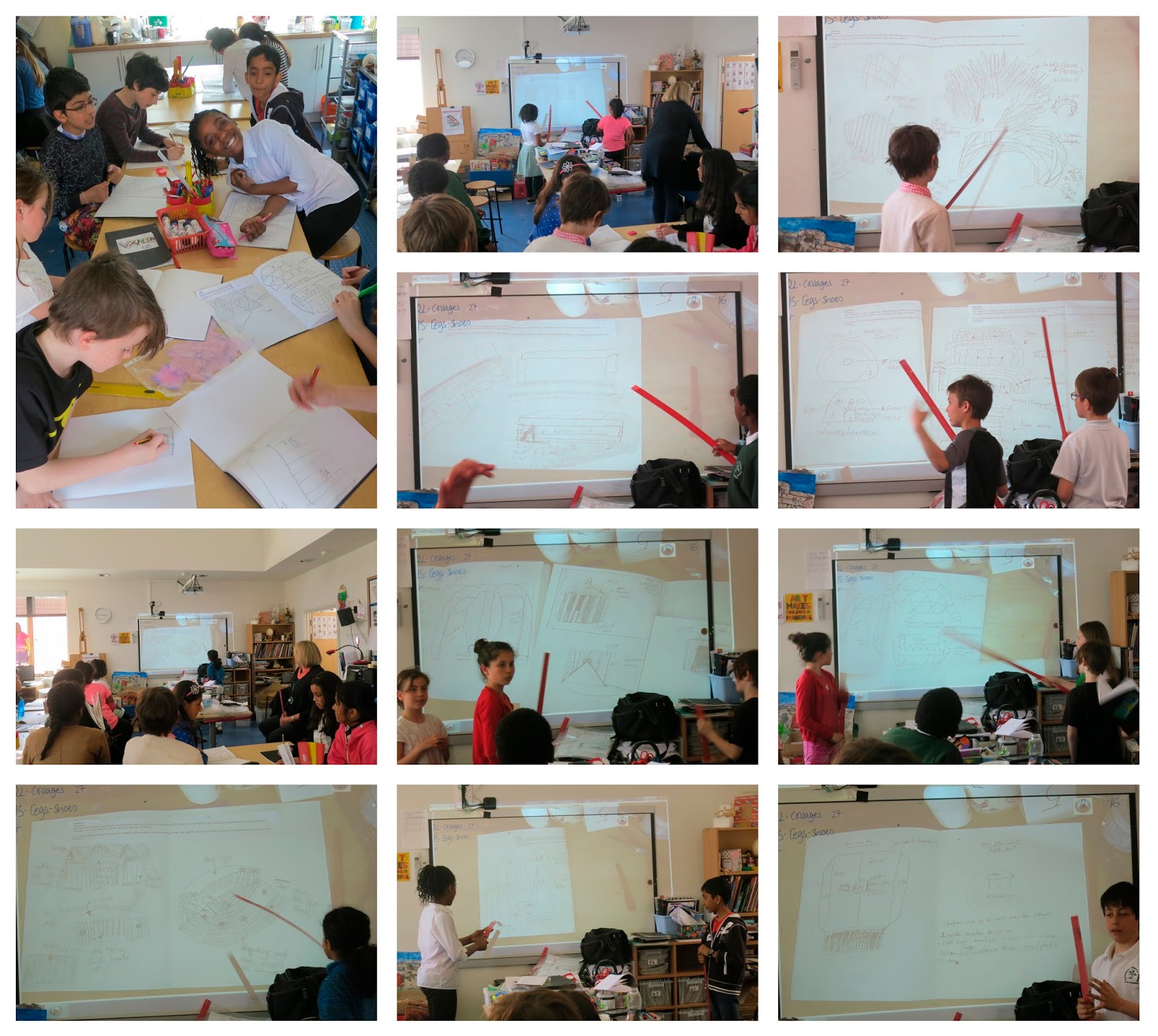
The Class was given the brief of designing a pavilion to engage with the environment and use energy in a productive way.  A short introduction on pavilions with a few examples was given.  With a relatively open set of parameters, the kids interpreted the brief with very unique and individual responses.  Their engagement and focus in the exercise was such that there was no hesitation to standing up and presenting their ideas and the reasoning behind them.


Their designs
Their designs were represented with skills developed from the structural and 3D drawing workshops and also contained lots of personal content.  As an exercise in imagining a space, the kids found it an opportunity to create something individual and meaningful to them.  Here the workshops started to become an medium for personal expression.


Model Making
Using the drawn designs as a guide, materials were gathered which could be used to create their work in model form.  This included straws, pipe cleaners, plastic and card sheets etc.


Models
Models were developed and refined over a couple of workshops.  


Mid-size models
Some of the model and structure ideas were  recreated at a bigger scale in the class room.  Quick experiments with different concepts and materials created some impressive results.

This, playing with cut and folded card.


This experimenting with newspaper made in to structural tubes to make framed structures.


Experimenting with interlocking sheets
Picking up on the ideas from previous years, estate agent boards were slotted to make a panel module which can be combined in to a number of different geometric shapes.  At this scale, the boards made dens which the kids really enjoyed building and sharing with their friends.


Large scale pavilions
The goal of the workshops was to create some full size installations from the models created in the class room.  The kids were keen to share ideas and combine their work to create different enclosures and spaces.

Here a series of vertical tubes swayed in the wind (the connection with energy).  The bases were able to be repositioned creating different enclosures and sight lines through, making it adaptable and able to respond to different personal preferences.


Here two designs using folded structures were combined, which added to the spaces within the pavilion and made the structure more efficient.  Energy was represented in the planes of the pavilion which could unfold or move to create different spacial arrangements.


This installation focused on personal energy and created a space to enjoy relaxation, experiencing the environment, passage of the clouds and the swaying of the installation in the wind.


The creativity of the kids seems boundless and it is encouraging that they saw the exercises as an opportunity to to invest so much personal content in to their work.  Collectively the class collected a great body of work and we are looking forward to developing the programme with the school in the next academic year.  

Saturday, 23 July 2016

London Kitchen

DesignBox Architecture has completed a kitchen refurbishment in South West London.  The kitchen faces north on to the garden and the brief was to make as much use as possible from the natural light and a palette of tactile and crafted materials.


The existing kitchen extension was replaced with a new glazed roof and sliding back door.  Large glass panels were used to minimise framework and help the space look as light and airy as possible.

Kitchen carcasses were relined with bespoke oak panels and doors.  Ironmongery was designed out.  Floating shelves were made in the same oak to match.  Concealed LED lighting to the underside of the shelves and wall units neatly illuminates the work surfaces.


The existing side walls were stripped of their plaster to reveal the original brickwork behind which came out really well.


New timber flooring to the kitchen was treated to match the existing in the living and dining rooms.  This helped to open up the ground floor of the house to appear one large space from front to back.


Precast concrete was used for the worktops, end panels and skirtings.  The colour of the glazing framework was selected to match.  Both worked well with the oak, brickwork and timber floor.


From the living room at the front of the house, views created to the end of the garden help to bring the space together with minimal visual barriers.  

Builders: Three-D Build
Glazing: Marshall Double Glazing
Concrete: Paul Davies Design
Photographs: Corin Ashleigh Brown

Monday, 16 May 2016

Transforming Polyhedra

Spaces that can transform have important potential for architecture and building design, weather it is for logistical reasons (transporting buildings as a smaller volume) or for operational uses (if the building needs to expand to open and shrink to close, for example).

We have been experimenting with different types of transforming polyhedra at Architecture for Kids, looking at the Jitterbug, Hoberman structures, Juno Spinners and others.   In addition to any Architectural value, creating mechanical moving structures has proven a lot of fun.

Experimenting with transforming polyhedra

Jitterbug
A discovery attributed to Buckminster Fuller, transforms between octahedron and cub-octahedron. It also demonstrates to kids the inherent structure found in triangular shapes, and how this lack of structure in the quadrangle can be used to the advantage of the Jitterbug's articulation.

We have been assembling Jitterbug's using modular origami.

A quickly constructed origami jitterbug
Hoberman Structures
We love the Hoberman Sphere!  It's always great fun in class. The immediate attraction is that an operation to one joint affects the whole model. Different Hoberman spheres work with different members of the Archimedean Solids which has increased class interest in polyhedra, their differences and how they work. 

Polyhedra-head: Playing with the Hoberman Sphere
and framed structures.
Expand-a-ball similar to the Hoberman Twist-O

Juno's Spinners
My favourite, Juno's Spinners were developed by Junichi Yananose.  They are polyhedra held together with an internal structure which also acts as a mechanism to allow them to expand. Rotational joints at the junctions between the structure and panels allow this movement, and like the Jitterbug and Hoberman Structutes, the model expands and contracts uniformly. 

Making Juno Spinners

At first they look complicated, (they are ingenious) but the templates are available on Juno's website and they are straight forward to template, cut out and assemble. We've been using polycarbonate sheet with eyelets for the joints. For most models no real instructions are required because the geometry constructs itself. 

These are useful exercises to de-mistily geometry and the apparent complexity of movement. It is also good to help develop kid's motor skills with the tracing, cutting, folding and assembly involved, but these tasks don't take long and the goals of finished models are quickly realised.

Thursday, 5 May 2016

Drawing in Space

I'm sure Alexander Calder would have taken to 3D pens if they had been available. His wire sculptures of faces and figures and experiments in 'drawing in space' might have been a lot quicker to produce and resulted in many more studies.

From the Calder review in Culture Whisper

But for kids, artists and architects today they are a very useful resource for creating sculptures and spacial studies quickly, to capture ideas and demonstrate skills in 3D thinking. 

Instinctively working in 2D

To begin with it does take a little practice and thought. When used by kids for the first time, they often set out their work on a flat sheet of paper and replicate a single 2D design. This produces a result but might not have the depth of character as a 3D line sculpture, which takes on a new life when seen using shadows, like Calder's work. 

Trying to replicate 'drawing in space'.

Creating the design in a number of parts, using a flat paper surface to create a series of single curve components, allows the overall piece to be constructed into a 3D assembly which is closer to what Calder was trying to do. We could all be great artists! 

A family of sculptural heads

It demonstrates how the simplicity of the line is a such a powerful tool for representing an idea, provoking thought or raising a reaction. 


Wednesday, 27 April 2016

Flexible Building Skins

Adventures in 3D printing highlight several valuable examples of surfaces which accommodate double curve geometries and can even transform to create flexible skin-like surfaces.  The possibilities of these are exciting and should be of interest when considering Architecture's futuristic aspirations for moving, transforming or shape-shifting building structures.  Here are some examples of prototype flexible skins, available to print, test and experiment with:

Flexible Skins
Mesostructured Cellular Materials:  3D printed structures with the ability to deform and deflect in multiple directions as a result of their structural and geometric arrangement.

Mesostructured cellular sheet by Andreas Bastian
On Thingiverse  and his blog site

These examples by Andreas Bastian, with other examples of double curve geometries below:

Andrea's other experiments include cellular structural geometries with 3D printing, post-formed over double curve geometries.  These also offer an insight in to how double curve skins could evolve.
Delft University is always a hub of innovation.  These student experiments have led to similar positive results:

Flexible materials developed by Students at Delft University.

Stereolithographic fabrics: There are a variety of examples of stereolithographic fabrics produced through 3D printing.

3D printed fabric developed for clothing by Richard Beckett

Chainmail: An old invention made a lot simpler to produce with 3D printing.  Geometric variations and additions to the units such as scales or feathers add to the possibilities of the material.

Chainmail by Kacie Hultgren.  Square geometry used.
Scale mail armour by Tom West.
Scales could offer some weather resistance in a building application.
Closest I've seen to replicating shark skin with flexible double curved geometries.

Hexchain: A variation on the above using tessellating shapes with mechanical flexibility to adapt to double curve surfaces.

Hex Chain from Jay Jeon.  A variation on scale mail.  

Flex Mesh: A kit of parts with mechanical flexibility between the components to allow movement and tolerance in three dimensions.

Flex Mesh uses flexible components with different geometries to achieve flexible 3D surfaces

Fashion
3D printing is leading the way in fashion with developments to produce materials with mechanical flexibility to replicate fabrics.

3D printed fabrics by Iris van Herpen.  

Flexible fabrics exhibited at the NYC 3D Print Show.

Mechanically jointed geometric structures to create a flexible fabric by Kinematics

Kinematics Petal fabric

Footwear
3D printed trainers are on their way from Nike and Adidas, developed with 3D printing because of the potentially superior support and mechanical flexibility which this manufacturing method might offer.

3D printer trainers coming from Nike and Adidas

Accessories
3D printed clutch using rectilinear chain mail shown above. 

Clutch by Kacie Hultrgen

3D printing is drawing a lot of interest in architecture and building design, but that doesn't mean that building types need to be the same rigid structures or that site processes and prefabrication methods need to follow established patterns. It is useful to look beyond the building industry, into other areas of design and manufacture to see what neat ideas are with developing an a different scale.  Maybe one day buildings might be flexible with the ablity to move and transform as Ron Herron imagined. 

Monday, 15 February 2016

A load of old balls

Looking at the development of double curve geometries in building materials I was drawn to the design of sports balls and in particular footballs to see where developments in this area can inform building structures and architecture, as a source of inspiration and reference.  Materials, geometries and fabrication processes have developed to enable the products to be accurately made and perform under specific structural loads and performance criteria.

Relating to the Building Industry
From a building point of view, the sheets of material which make up the ball's outer skin might equate to prefabricated building panels and some key difficulties remain in creating double curved panels which are:
  • Achieving the optimal size of the panels or components within the restrictions of manufacturing, logistical and site handling constraints,
  • Details of the junctions between panels including accuracy of fit and position, especially where multiple panels meet at corners, or where junctions are required to meet accurately along complexed curved edges,
  • Sheets can often curve in one direction but curves in two directions without the special preparation or a mould is often difficult, 
  • Being able to achieve the desired design with a controlled set of geometries.  Creating multiple double curve moulds adds significant cost to a project.
Curved building materials and issues of logistics,
accuracy of fit, weather tightness and prefabrication

Football Ball Design
The evolution of the design of the football has addressed some of these issues and offers parallels.  Looking at how the product has been optimised over time suggests a few tricks which might work for the structural envelopes of buildings.  For example:

c.1937 Football design 
Traditional football consists of:
  • 18 panels,
  • 32 three-panel junctions,
  • 48 linear seams
Use of linear strips of materials to make larger double curved panels.  Strips bend in one direction, with the seamed panels creating the curve in the second direction.  Six of the larger panel arrangements work like a rounded cube - set around an x, y, z, (three) axis arrangement.

1963 Adidas Santiago World Cup Ball

1963 Santiago Ball consists of:
  • 18 panels, of which 6 are octagons and 12 are symmetrical polygons,
  • 40 three-panel junctions,
  • 58 linear seams
Arranged with a greater understanding of spherical geometries but still based around an x, y, z (three) axis arrangement.

1970 Adidas Telstar World Cup Ball

1970 Adidas Telstar Ball consists of:
  • 32 panels, 20 of which are hexagons and 12 are pentagons, 
  • 58 three-panel junctions
  • 90 equal linear straight seams
Based on the truncated icosahedron, one of the Archimedean polyhedra, also known as the Bucky ball or carbon 60 atom.  Probably the first ball design which adopts more complex three dimensional geometric design.  The pentagons align with six axis rather than three as used before.  The quantities of panels, seams and junctions make it relatively more complicated than the others.

2006 Adidas Teamgeist World Cup ball

2006 Adidas Teamgeist World Cup ball consists of:
  • 18 panels of two types (6 of one and 8 of the second),
  • 20 three-panel junctions,
  • 36 seams, of which 24 are curved and 12 are straight.
The Telstar design has probably become the most common football ball design and has experienced a long design life, but more contemporary designs have investigated how the ball and its performance can be optimised with fewer components and junctions.  The Teamgeist  ball demonstrates this.  It also returns to a three-axis geometrical arrangement.

2010 Adidas Jabulani World Cup Ball

2010 Adidas Jabulani World Cup ball consists of:
  • 8 panels of two types (4 of each type).  
  • 12 three-panel junctions,
  • 18 linear seams of which 12 are long and curved, 6 are short and straight. 
These panels are pre-moulded in to a double curved shape to assist precision of build and performance.  The ball's performance is assisted with an additional intermediate lining between the outer skin and the bladder.  There are less panels and junctions than the Telstar ball, and it is based around a four-axis geometry.

2013 Nike Ordem Premiership Ball
2013 Nike Ordem is based on a dodecahedron and consists of:
  • 12 equal panels, each fabricated in to six sections which adapt to take on a double curved shape,
  • 20 three-panel junctions,
  • 30 straight linear seams.
A relatively simple design based on the dodecahedron.  The pentangle panels are articulated to create an effective double curve.  It might be seen as a simplified and optimised take on the Telstar ball design.  As with the Telstar ball the pentagons align a six-axis geometric arrangement.

2014 Adidas Brazuca World Cup Ball
2014 Adidas Brazuca World Cup ball design consists of:
  • 6 equal cruciform panels,
  • 8 three-panel junctions
  • 12 curved linear seams
The cruciform panels are effective for curving down the long arms with the pressure of the bladder creating the second curve across their width.  The curved pattern of the seams meeting around a spherical geometry presents an assembly tolerance / accuracy of fit issue which looks dynamic but might prove difficult to achieve with building materials.  This ball returns to a three-axis geometric arrangement.

It doesn't always look the same when it comes through the post.
Junction alignment of panels around a double curve geometry.

A Load of Old Balls

A Load of Old Balls Simon Inglis

Simon Inglis's book A Load of Old Balls (2005) examines the development of the ball in British sports up to the twenty-first century and reveals much relevant information in relation to the development of materials, manufacturing processes, geometrical development and performance reliability.

On materials, it charts the greatest advances with the development of synthetic and composite materials to replace natural materials and animal parts.  It describes how material technologies from different industrial sectors were investigated to meet the requirements of the developing sports industries.  Mass production and standardisation allowed developments in ball design to progress with greater accuracy of manufacture and performance precision.  Even the 'crack' of the golf ball when hit by the driver is explained as a carefully engineered acoustic property.

Other Designs and Experiments
Haresh Lalvani's soccer ball

More recently Haresh Lalvani, Professor of Architecture at the Pratt Institute, has been experimenting with tessellating polygons which combine to create three dimensional spheres or ellipsoids.  His work is available to see at the Patents site.


Using intersecting cylinders set out around the axis of different platonic solids (cube 3-cylinders, tetrahedron 4-cylinders and dodecahedron 6-cylinders) allows surfaces to come close to double curve geometries, using single curve planes.

The cockpit roof lights for the Central Module at Halley VI
designed with the idea of intersecting cylinders
as an economy over double-curved glass

Examples in Buildings

Examples of double curved geometries in building materials are mostly seen with timber, concrete, glass, perspex, metal and FRP:

Achieving double curved geometries with building materials